Hi ghouls 👋🏻 Today I wanted to try my best to tackle a debate that can get a little heated in certain circles. The blogging world is the kind of place that is more likely to have a debate than resort to mudslinging and name-calling, so my main concern here is that I’m able to put my thoughts down in a coherent way, but because I’m a scatterbrain, this may end up being a jumbled mess.
The argument that horror is a misogynistic genre isn’t a new one but it also isn’t one that I’ve personally seen crop up in recent times. In the 1980s, one of the biggest critics of the genre was Roger Ebert who often referred to the slasher genre as “Women in Danger” films. Ebert was entitled to his own opinions about the genre and was a professional film critic, whereas I’m just some nobody with a blog and a Masters degree in literature which requires a different skillset from studying film.
I’m not here to provide some deep analysis, I’m just here to dump my brains out into a blog post and hope that it ends up making sense!

HORROR HEROES ARE OFTEN WOMEN.
It has become so commonplace for the heroes of horror movies to be women that it’s now seen as a staple of the genre. I remember watching a BTS feature on Nightmare on Elm Street 2: Freddy’s Revenge in which Wes Craven stated that a big reason why that movie didn’t click with audiences was that the main character was a boy rather than a girl. I disagree with him because I think there are plenty of reasons why that movie doesn’t work as well as the first, but the hero’s gender isn’t one of those to me.
Women being the main characters in horror hasn’t always been the case as a lot of horror stories from before the mid 20th century had male heroes with the women being victims or love interests who had to be saved. There are obvious exceptions to this like Rebecca, and Jane Eyre but even stories like Psycho have male heroes, whether they are memorable or not.
I think that women being the heroes is a very welcome change because it gave those characters agency and makes them strong in both the literal sense and the well-written sense. However, just because the heroine is well written, that doesn’t necessarily mean that the other female characters are three-dimensional characters.
FINAL GIRLS.
The term “final girl” was coined by Carol Clover in her book Men, Women, and Chainsaws which is a book that is often highly recommended when looking at horror from an academic perspective. While we often are made to identify with the final girl, and she is often the best-written character, in some of the more forgettable (or just not that good) horror stories, the Madonna-Whore complex can, unfortunately, come into play.
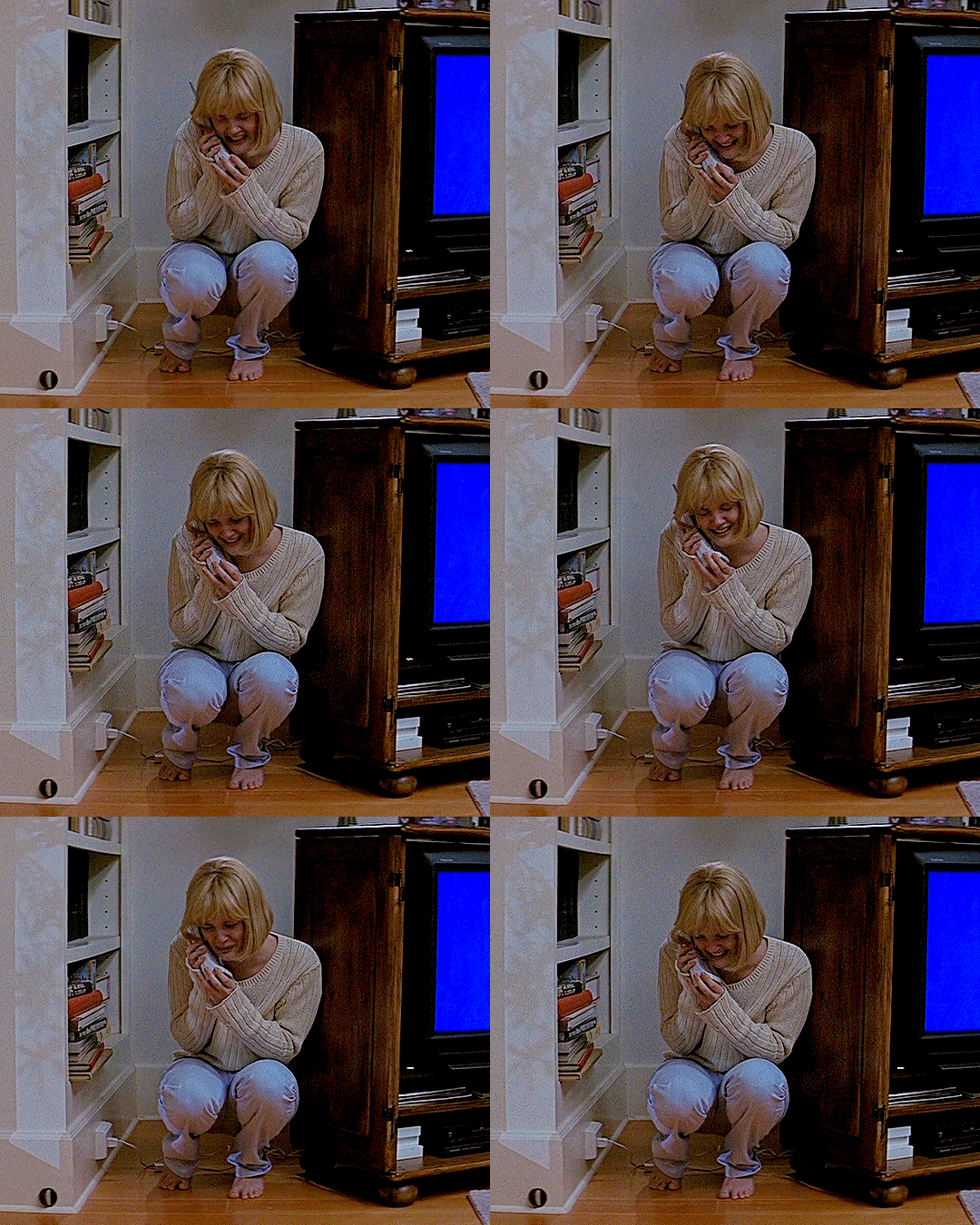
The final girl can be the morally superior one compared to her “morally corrupt” friends. She doesn’t have sex, she refuses alcohol and drugs, and she almost never takes her clothes off as opposed to her friends who could be viewed as promiscuous and disobey Randy Meeks’ “you can never have sex” rule from Scream. It doesn’t always sit right with me that in older horror media, the girls who are killed off as given those “undesirable” traits to make the final girl look better in comparison. This doesn’t happen as often anymore since attitudes towards how women should be and act have changed so much since the 1970s.
Something interesting that feminist critics have brought up is that having a female protagonist in horror (which is often seen as a “man’s genre”) forces male audiences to identify with a woman as the point of horror is to make the audience feel the terror that the characters experience.
MORE MEN ARE KILLED IN HORROR THAN WOMEN BUT…
If you’re into numbers and statistics, you may be interested to know that there are more male victims than female victims in horror media. Some people have used that statistic as proof that the genre is not misogynistic, but it’s not necessarily the number of bodies that matters, but the way in which a victim is killed.
A man getting a knife in the back and dying instantly isn’t the same as a woman being tied up, having her clothes torn off of her body, and being slowly dismembered in lingering shots. I’m not saying that female characters aren’t allowed to be killed in gruesome ways just because they’re women, I’m saying that there should be a balance and we’re starting to get that balance.
There’s a big subset of horror fans who are very into extreme horror (sometimes a little too much, but that’s just my opinion) and a lot of those movies don’t appeal to me because so much of them contain such extreme violence against women. Nyx Fears is a great YouTuber who often talks about extreme horror and I appreciate her takes on it because she comes at them from a trans woman’s viewpoint, which differs greatly from mine as a cis woman. There’s nothing wrong with liking extreme horror, but I do think that the more avid male fans of it should realise why so many people are wary of it. I don’t like to make assumptions about whole subgenres, but I personally don’t want to watch 90 minutes of women being sexually assaulted and tortured.
HORROR IS MORE POPULAR WITH WOMEN THAN PEOPLE THINK.
An unfortunate part of genres that can be seen as a niche is the idea that it’s actually “for men”. It happened with video games, sci-fi, and it even happens with horror. I personally don’t understand why that’s an idea because I know more women, girls, and AFAB people who are into horror than men.
There’s still this weird stigma that women don’t like horror because we’re more emotional and don’t like to be scared, but horror is about so much more than just being scared. Horror can be an empowering genre for women because we can often identify with the heroines, and while my personal favourite horrors have male protagonists, experiencing stories where women fight back and defend themselves can be cathartic for me because my younger self would have aspired to be like those women when she was being bullied and felt weak.
talk to me!
What do you think? Is horror inherently misogynistic or has it become an empowering genre for women?


I’ll confess that I don’t have strong feelings about misogyny in horror, mostly because I don’t watch much of it (I guess I fit the “stereotype” on that—I’m just one person, though). I still found it really interesting to read your thoughts on it, though. You make some great points, especially about women heroes in the genre.
Author
I’m glad you found it interesting, Nicole! I got a little worried that my thoughts were too jumbled to make sense 😅