
Hi friends! 👋🏻 Lately I’ve been feeling pretty confrontational (which is odd for me) and it’s thanks to the title of a certain classic dystopian novel being thrown around by anti-vaxxers and their ilk.
One thing that you learn when studying literature is that there are no objectively wrong interpretations, but I don’t know if I fully agree with that. There are some out there interpretations, but some people are absolutely wrong about a text and I want to say why I think they’re wrong without getting too analytical. If you didn’t know, I have a Masters degree in English and I like being able to use it as much as possible, whether that’s by rambling about things that people don’t care about, or putting it into blog posts.
Before I jump right into roasting these interpretations, I want to briefly introduce the concept of Death of the Author, which was proposed by Roland Barthes. This concept states that the author’s intentions and background should hold no weight in how their work is interpreted. There are some issues that I have with this because while there are authors who just set out to tell a story, there are others who write to provide a moral message or to evangelise their beliefs, whether that’s religious, ethical, or political (Ayn Rand or a certain white supremacist group founder who doesn’t deserve to have his name on my blog).
I don’t like to say that some people’s interpretations are wrong, but sometimes you read someone’s analysis of a piece of work and it’s obvious that they either didn’t read it or just paid attention to half of it.

Alice’s Adventures in Wonderland and Through the Looking Glass by Lewis Carroll
What people think they’re about: Drugs. Lots and lots of drugs.
What they’re actually about: To me, there is nothing more annoying than when someone looks at a piece of media that has surreal elements or things that are just strange in it and their first thought is “wow, the author must have been on drugs to have made this.” It’s such an unimaginative reading and to see it applied to a piece of children’s fiction tells me that people who think that are boring.
I totally get why the Walt Disney movie Alice in Wonderland was popular with drug users in the 1960s because it has bright colours and beautiful animation, but applying 60s drug culture to a children’s novel that was written in the Victorian era is silly.
The Alice books aren’t really about anything because they started as silly little stories that Lewis Carroll would tell to his friend’s children and any interpretations about the novel being a commentary on the contemporary school system or the British Empire popped up later on.
To me, the idea that the book must have been written while Carroll was under the influence of some kind of substance is ridiculous because it shows that some people just can’t comprehend that other people are just weird or eccentric without any meaning behind it. As far as we know, Carroll wasn’t a substance user of any kind and was just an eccentric man who enjoyed putting wordplay, satire, and fallacies into his children’s novels when he wasn’t busy being an Anglican deacon. There are debates about Carroll’s sexuality and friendships with children but that is not my argument to make and this is not the place to make it.
The Great Gatsby by F. Scott Fitzgerald
What people think it’s about: The 1920s were so fun because everyone had money and went to parties and was glamourous.
What it’s actually about: I don’t really think that I need to explain what The Great Gatsby is really about because it’s Literary Analysis 101 to talk about this book.
The main takeaway from this book is that the American Dream is absolutely bogus thanks to the concept of Old Money and New Money. Gatsby is New Money because he was born into a poor family and got his fortune through “good old-fashioned hard work and determination” while Daisy, Tom, and Jordan are Old Money because they were born into rich families and never had to work a day in their lives. Even though they’re all rich, they’re not the same. The lifestyle these people (Gatsby included) are portrayed as being empty and shallow and the book really beats it into the reader that no amount of money or notoriety can ever give someone what they truly want.
In Gatsby’s case, what he really wants is Daisy, but his money and possessions can’t give him Daisy back because they’re just not the same. Her white supremacist brute of a husband is Old Money and that gives her a social standing. There’s a lot to be said about social class here and how the American Dream has always been a broken concept due to class differences and people who are born rich looking down on even “self-made” millionaires.
Basically, all the characters in this book suck and shouldn’t be looked up to as role models for success or beauty or anything. I hate this book if you couldn’t tell.
Animal Farm and Nineteen Eighty-Four by George Orwell
What people think they’re about: Communism bad
What they’re actually about: Here is a wee fun fact for you: I have studied George Orwell’s political writing twice and I’ve read Nineteen Eighty-Four three times. The first time because I wanted to, and the other two times for study reasons. I feel like I can say with confidence that Orwell has been so badly misinterpreted by the general public and school syllabuses that his name just gets thrown around without any thought or acknowledgement of what his political beliefs were.
First and foremost, Orwell was not anti-socialist or anti-communist, he was anti-totalitarian. While I am sceptical of communism because of the appalling history of human rights in communist countries, it is important to know that Orwell was commenting on the Soviet Union as it was under the rule of Stalin, who was an awful dictator who persecuted his own people and was making attempts to rewrite history and keep people under control. 1984 was a controversial book when it was first released not just in the USSR, but in the UK because the Soviets were our allies during the Second World War.
Orwell thought that the Soviets weren’t left-wing enough and when looking at Stalin’s regime, it’s easy to see why. Jewish people, LGBTQ+ people, and Romas were persecuted by the government, secret police existed, censorship was widespread, and forced labour camps were used. I am aware that conditions in the USSR improved after Stalin but Orwell wasn’t alive to see that and his works are critical of Stalinism, not communism as a whole.
When looking at Animal Farm closely, it’s very clear which character is supposed to be which leader of the Russian Revolution as the story satirises how the USSR moved further away from true Marxism after the death of Lenin. Napoleon, the pig who takes control of the farm, is a very clear stand-in for Stalin who moved the government away from Marxist-Leninism and further towards harsh totalitarianism.
I can’t spend all day talking about Orwell (as much as I would want to because it means I’m putting my MA in English to good use), but all I can say is if your teacher told you that Orwell was anti-socialist or anti-communist, your teacher sucked and so did the syllabus.
Lolita by Vladimir Nabokov
What people think it’s about: A taboo romance between a promiscuous young girl and an adult man OR a celebration of paedophilia and CSA.
What it’s actually about: It really should not have to be said that Lolita is not a romance story. Lolita is a story about child sexual abuse, and while it’s not sugarcoated, it is told by a purposely unreliable narrator who uses very carefully chosen language to make his abuse seem like it’s romantic.
There is nothing romantic about a child being kidnapped and constantly assaulted by their stepfather. You don’t need to have read the book to see that. Something that I find very disturbing in the way that Lolita has been so badly misinterpreted is that when looking at criticisms of the book, critics who see the book as being condemning of paedophilia are women, while a lot (but obviously not all) of critics who see Dolores as being the “nymphet” her abuser describes her as are men. I personally find that very concerning because girls are sexualised from such an early age and I’ve seen too many real-life statutory rape cases where teenage girls have been blamed for being abused by adult men because “they should have known better”.
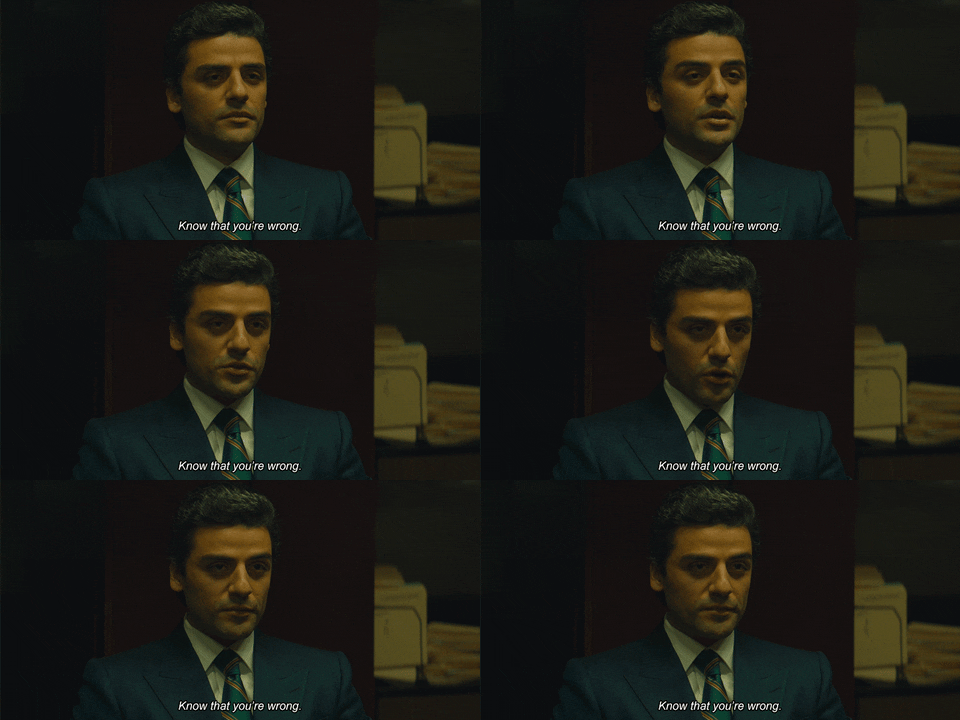
While I personally do think that Death of the Author has some merit to it and Nabokov said that the story has no moral because readers should be smart enough to see through Humbert’s attempts at gaining sympathy, it’s important to note that Nabokov objected to people calling Dolores a “young woman” because he knew that she was a child. Your own interpretation is your interpretation and that’s fine, but when the author comes out and says “you are wrong”, then you’re wrong.
I don’t want to point fingers, but I will point fingers and say that the reason why the book has been so badly misinterpreted is the fact that both of the movies frame the story as being a taboo romance between an adult man and a teenager who is approaching the age of consent, rather than an abusive one between a paedophile and a child. Filmmakers thought that making a true-to-text adaptation was too much to put on screen and now we have this mess to contend with. Thanks for that, Stanley Kubrick.
Dracula by Bram Stoker
What people think it’s about: An evil but sexy vampire stalks young women and seduces them into becoming evil sexy vampires.
What it’s actually about: This is a little complicated because there are so many different readings of Dracula that I can’t sum up in one fun little blog post. Some have interpreted it as being xenophobic anti-Eastern European propaganda, some see it as a parody of Invasion Literature, others see it as being erotic, and then some people see it as absolute shlock. I’m not going to say that any of these readings are wrong because I can personally see why they have sprung up.
What I will focus on, however, is the erotic aspect. I can’t argue that vampires haven’t become inherently erotic figures because so much vampire iconography comes from human sexuality: compulsion can be likened to seduction, they are almost always seen drinking blood from the side of the throat which is an erogenous zone (when in reality that’s where the carotid artery is and arteries carry blood that you wouldn’t want to drink), and in modern vampire fiction, they’re always portrayed as being beautiful and sensual, which is a far cry from the creature that originally appeared in folklore and inspired Stoker.
Before we had Bela Lugosi playing the Count on stage and screen, vampires were literally walking corpses and the book version of Dracula is not an exception. From the first time he appears, he’s described as being grotesque and odd, and it’s heavily hinted that he’s lying about his past because there is no way an old man who appears to have never left his home country could speak fluent English without a hint of a foreign accent.
While the book doesn’t portray the Count as being a sexual figure, it’s hard to deny that there is a lot of sexuality present. Dr Seward likens a blood transfusion to a sex act, the Brides descending on Harker has uncomfortable sexuality to it, and this is common in Victorian horror. Victorians were infamously puritanical when it came to sexuality and to me, the book seems to be using the vampire as a way to explore society’s fears of sexuality and especially female sexuality. Dracula turning women into vampires is never portrayed as a good thing, or a sexy thing because it plays on society’s unease of sex at the time, and if you wanted to stretch it a little further, the male characters fear that if the Count can do this to women, he may end up doing it to men too, playing with another societal fear, which is homosexuality.
This is turning into my uni dissertation so I shall leave this here for now. Both my BA and MA dissertations were on vampires and I could talk about vampires for years.
talk to me!
Which books do you think have been misinterpreted over time? What do you think they’re actually about?
I love this post! I couldn’t agree more on all of these. I truly dig your style and tone, especially “people who think that are boring” and “your teacher sucked and so did the syllabus.” I’ve long thought that another wildly misinterpreted book is A Clockwork Orange, especially since its U.S. release was missing the crucial final chapter that, to me, completely changes the story’s arc and in many ways makes Alex even worse as a human being.
I still have yet to read A Clockwork Orange but I’ve seen it get so badly misinterpreted too.
What a great post! I agree with so much of this.
I also dislike the “the author was on drugs” commentary on a lot of books. Maybe they were, maybe they weren’t. That doesn’t really contribute to discussion of the book or what it means or how one interprets it!
And I think a lot of the “Dracula is sexy” comments must come from people who have not actually read the book but maybe heard other people say this or saw a movie adaptation or something . . .
I personally feel like unless the whole point of the book was to be about drugs, it doesn’t really matter whether the author was writing while under the influence of something. For someone like Hemingway, it makes sense since he tended to write blackout drunk and it shows in his work, but Alice in Wonderland can be so innocent at times.
I agree with you on Dracula, so many of the movies are committed to him being sexy but the book treats him as if he’s an actual beast.
This is so interesting! I haven’t really read classics myself; though ofcourse we did needed to for english classes but erh.. I never understood a word back then and just guessed my way through 😅 So seeing the misinformations VS reality was quite a nice read.
I might be absolutely wrong, but wasn’t lolita supposed to be specially made to make people aware of the whole problematic of the rape culture & pedophilia and all that? And then some people came and put the « love story » sticker on it? 🤔
You’re exactly right about Lolita! Nabokov made the mistake of thinking that every person who read the book would understand that he was condemning how Dolores is portrayed by the narrator, but those people who misread it made the movies in the way that they saw it and the damage that’s done has been pretty bad.